


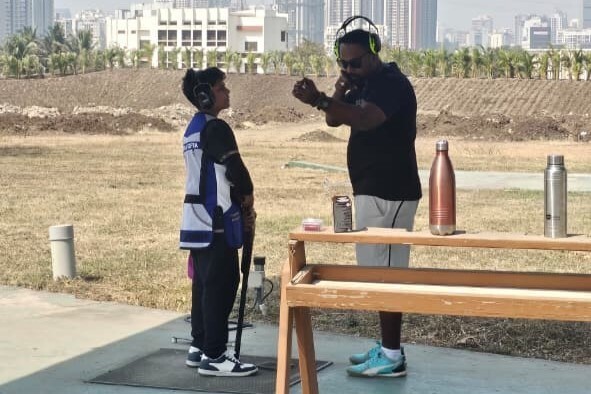
Although still in the early stages of his coaching journey, Ralston Coelho of India has already made a promising impact in shotgun shooting through his commitment to developing the next generation of athletes.
Coaching students from various clubs across India while completing the ISSF B Coaching Course, Coelho has helped guide young athlete to national team trials and international success, including a junior individual bronze and team silver medal at the 2025 Asian Championships.
In the latest edition of Coach’s Corner, Coelho reflects on his transition into coaching, the importance of building strong fundamentals, and the lessons he has learned while working with athletes at the beginning of their high-performance careers.
Coaching students from various clubs across India while completing the ISSF B Coaching Course, Coelho has helped guide young athlete to national team trials and international success, including a junior individual bronze and team silver medal at the 2025 Asian Championships.
In the latest edition of Coach’s Corner, Coelho reflects on his transition into coaching, the importance of building strong fundamentals, and the lessons he has learned while working with athletes at the beginning of their high-performance careers.
What is your coaching philosophy in one sentence?
Hardwork and smartwork - always outperforms talent.
What is the one habit you try to build in every athlete you coach?
Discipline and trust in the process
At elite level, what separates a good shooting sport athlete from a great one?
The good worry about scores. The great ones worry about getting their technique right – irrespective of their scores. The elite show up every single time early even when the previous day's training session or a match didn’t go as planned – the average – keep brooding about what went wrong and what they should have done right.
How do you balance technical training with mental preparation?
To be honest I first thought mental training to be an external job – and I tried the same – getting my athletes to speak to various mental coaches. From this experience I realized that being a coach – I have to focus on the 360 degree development of my athletes. Which means – if I don’t know enough about mental coaching – I need to ensure I learn – and which I did. Mental coaching is not easy – every athlete responds differently to this stimulus – and hence this has to be tailored to each one.
I have created a whatsapp group with all my students in it. While some instructions are common and hence find their way in the group as general instructions – others are more athlete specific and hence it is feedback given in one-on-one sessions.
At the shooting stations when I am behind them observing and guiding during their technical training sessions – I take the opportunity to speak to each one about the mental aspect of the game.
I think the biggest issue that most athlete’s face is that they - Forget to “Remember to Remember” all that they have practised/trained hard for during practice sessions. My main role as a coach is to make them Remember when it matters the most. I am so confidents of my style of technical coaching – and that it can get to be the best – the missing link that remains – and I continue to work on it – How do I make them Remember to Remember on match day.